
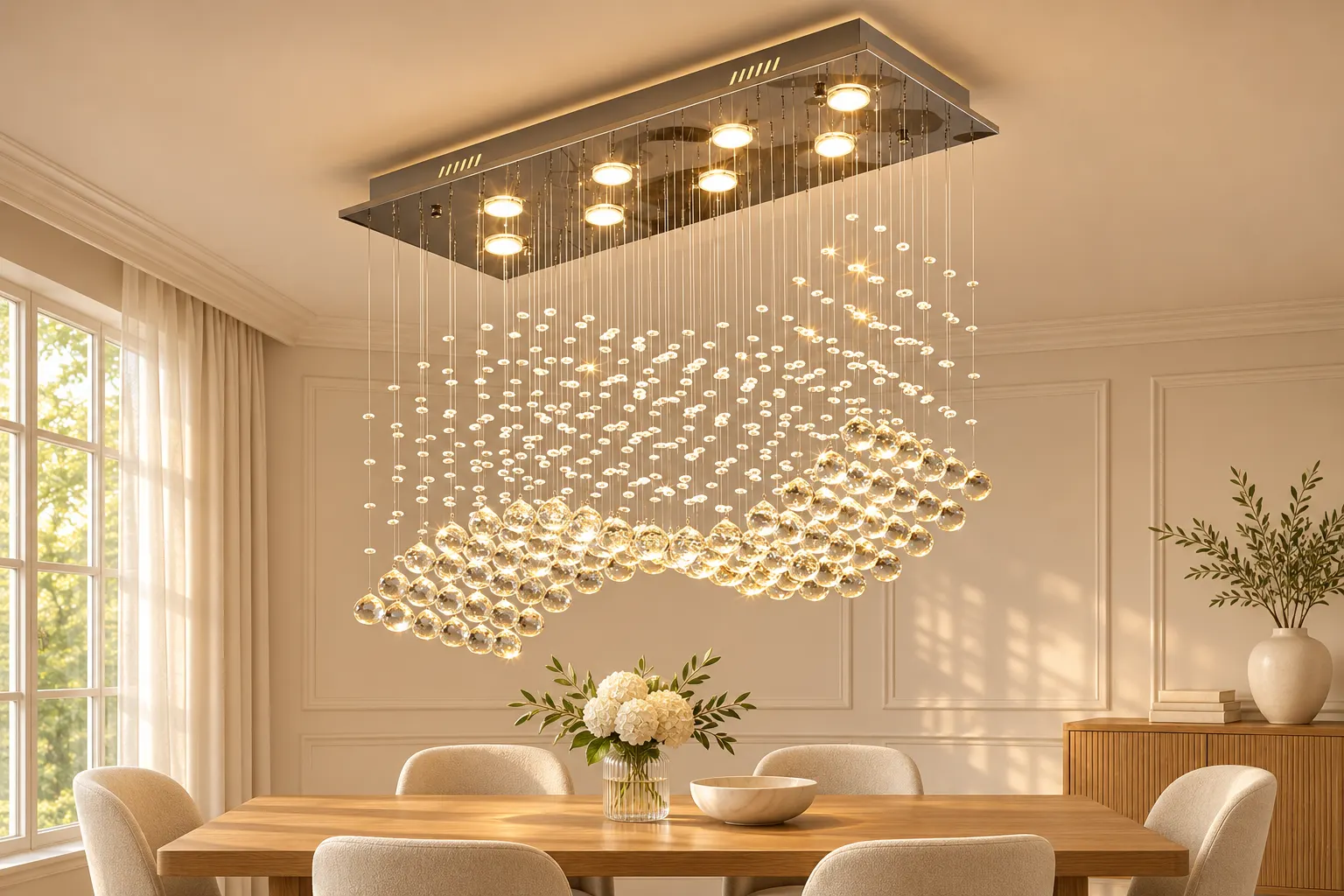
Start with the dining table, then check the whole room. A chandelier needs to suit the table's shape, leave comfortable sightlines and fit the ceiling height. A custom design lets you resolve the footprint and drop together, rather than choosing a beautiful fixture and discovering it does not fit.
1. Let the table shape guide the chandelier
A long rectangular table often works with an elongated chandelier or a linear arrangement. A round fixture can echo a round table. These are visual starting points, not fixed rules: an open-plan room, nearby pendants or an asymmetrical layout may call for a different composition.
Before choosing, mark the table position on your plan. Center the chandelier on the intended dining arrangement and check the view from the entrance and adjacent seating area.
2. Compare the fixture footprint with the table and room
Measure the table length and width as well as the room dimensions. A fixture that reaches too close to the table edges can feel crowded; a small fitting may lose presence in a large open room. Use a paper or cardboard outline to test the proposed footprint before approving a custom drawing.
For example, if your table is 180 × 90 cm, share those actual dimensions with your designer instead of asking for a standard six-seater chandelier. Seat count alone does not establish the available width or the surrounding circulation space. This is an illustrative brief, not a recommended chandelier dimension.
3. Set the drop from the finished ceiling
Record the finished ceiling height and the tabletop height. The usable space between them must accommodate the complete fixture, its canopy and suspension, while keeping seated sightlines comfortable. A deep crystal wave and a shallow ceiling fixture can have the same width but very different drops.
Test the lowest point using a temporary marker with the room safely unoccupied below it. Check the view while seated and standing, and consider whether the table could ever be moved. Have the final suspension and clearances confirmed for the actual site; a styling rule cannot establish safe mounting.
4. Check the light as well as the silhouette
Ask how the chosen components illuminate the table and whether exposed sources will create glare at eye level. Discuss color temperature, output, driver access and dimming compatibility before production. Crystal sparkle is a visual effect; it does not by itself confirm enough usable light for the room.
Keep the chandelier on a considered lighting plan with other sources where needed. Check the fixture's electrical specification and controls together rather than assuming every lamp or driver will work with an existing dimmer.
For a focused explanation of warm white and compatible controls, read our chandelier colour temperature and dimming guide.
5. Plan fitting and future cleaning
Confirm the fixture weight, ceiling structure and access for installation. Leave a practical way to reach light sources and clean the drops later. Discuss those constraints before the ceiling and furniture layout are finalized. Read about fitting and care enquiries.
A useful custom-design brief
- Room plan, table dimensions and photographs from two angles.
- Finished ceiling height, tabletop height and proposed light point.
- Preferred shape, finish and reference images.
- Ceiling drawings, access restrictions and installation location.
- Desired controls and the atmosphere you want after dark.
World of Lights manufactures customized chandeliers in India, with our own designers developing the form around your space. Share your dining-room brief to discuss the next steps. Images here are design visualizations; see real installation videos separately.
Sources and editorial approach
The topic was selected from public lighting guides that address table shape, fixture proportions and placement; no keyword-volume data was available. This article provides an original planning checklist rather than a universal sizing formula.
- Lumens: Dining Room Lighting Ideas & Tips — table shape, proportion and layered light.
- Pottery Barn: Dining Room Lighting — proportion to the table and room height.
Sources reviewed 7 November 2026. Final product and site requirements must be confirmed for the selected design.